
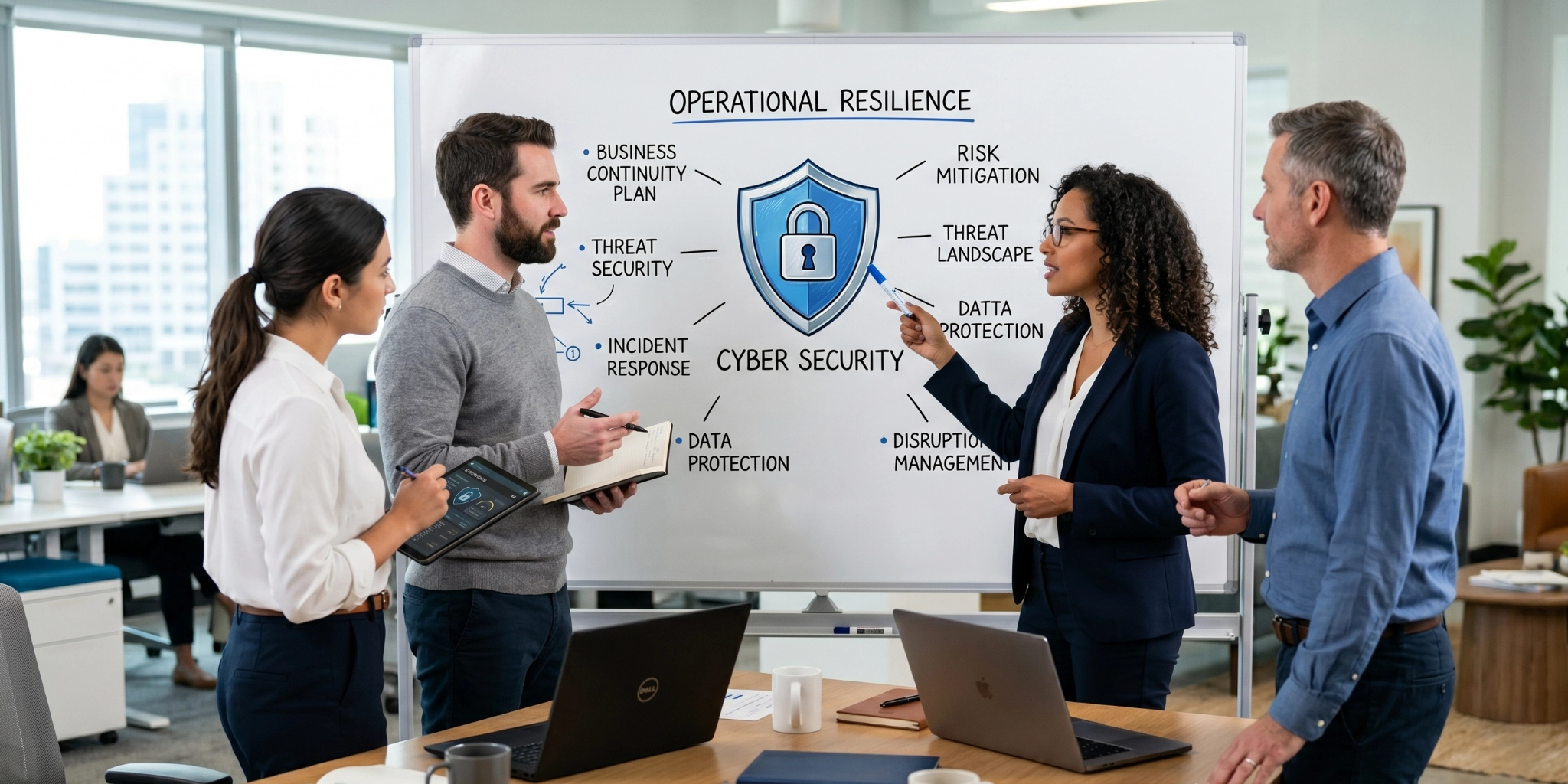
Every business owner or executive knows that the path to success is rarely a smooth line. At some point, things go wrong. It could be an internet disruption, a power cut, a server failure, or a critical team member falling ill. Some organisations seem to navigate these setbacks effortlessly, whilst others face severe disruption, costing thousands of dollars in lost productivity and reputational damage.
The capacity to withstand these bumps in the road with minimal impact is known as operational resilience.
While some might attribute this resilience to luck or an uncanny ability to predict the future, it is actually the result of deliberate, proactive planning. Operational resilience is about preparing for the unexpected so that your business can continue to function, adapt, and recover with minimal cost or downtime.
Proactive Risk Management versus Reactive Pain
When it comes to handling business disruptions, there are generally two pathways: the proactive approach and the reactive approach.
A reactive approach relies heavily on hope. It assumes that major disruptions will not happen to your business, leaving the organisation completely unprepared when an incident inevitably occurs. This lack of preparation often leads to significant operational strain, financial loss, and chaos as teams scramble to fix problems under intense pressure.
Conversely, a proactive approach is rooted in comprehensive risk management. Instead of ignoring potential vulnerabilities, an operationally resilient business identifies them early. This involves considering various scenarios, such as hardware failure, backup issues, communication outages, or natural events like flooding, and putting measures in place to reduce their impact.
Larger organisations often appear more resilient simply because they have experienced these setbacks in the past and have established frameworks to handle them. However, businesses of all sizes can achieve the same level of stability by choosing to be proactive rather than waiting for a crisis to occur.
The Digital Shift: Why Cybersecurity is the Foundation of Modern Resilience
In the modern digital economy, the nature of business risk has shifted dramatically. While physical risks to buildings, vehicles, and equipment still exist, the vast majority of operational vulnerabilities now reside in the digital landscape.
In fact, cybersecurity considerations now account for more than 60% of the total operational risks faced by a typical business. Because organisations depend heavily on cloud platforms, digital communication tools, online banking, and electronic data storage, a single digital disruption can halt operations entirely.
Therefore, if you are looking to significantly improve your operational resilience, enhancing your cybersecurity posture is the most impactful proactive step you can take. By securing your networks, implementing multi-factor authentication, conducting regular penetration testing, and training staff to recognise digital threats, you are effectively protecting the core infrastructure of your business.
Meeting the Gold Standard: Regulatory Frameworks
The importance of operational resilience is increasingly recognised by global regulatory bodies. In the financial sector, for example, stringent standards have been introduced to ensure that institutions can withstand both operational and digital shocks.
Two prominent examples are the prudential standards known as CPS 230 and CPS 234:
- CPS 230 (Operational Risk Management): This standard requires organisations to effectively manage operational risks, maintain critical operations during disruptions, and establish clear frameworks for managing third-party service providers.
- CPS 234 (Information Security): This framework focuses specifically on ensuring that an organisation maintains information security defences that are commensurate with the vulnerabilities and threats it faces.
While these standards are mandatory for financial institutions, they serve as an excellent blueprint for any business striving to achieve robust operational resilience. Implementing similar structured principles can help any organisation identify critical operations, map dependencies, and establish clear recovery strategies.
Build a Resilient Future with Vertex
Transitioning from a reactive state to a proactive, operationally resilient framework requires specialised knowledge and steady guidance.
At Vertex Cyber Security, we act as trusted partners to help businesses identify vulnerabilities, mitigate risks, and build stronger defences against modern disruptions. Whether you need to align with formal standards such as CPS 230 and CPS 234, or simply wish to secure your digital infrastructure to ensure continuous operation, our compliance platform (ALKE) and expert team can provide the support required.
True resilience is not about avoiding the unexpected: it is about being ready for it. Contact the expert team at Vertex today to discover how we can help enhance your organisation’s security posture and safeguard your business continuity.